
10 km route in the “Amsterdamse Bos”, corrected to reach 10 km (was 9.6 km according to Google Earth, click on pictures to get a single, larger view).

Same but with Google Earth distances(click on pictures to get a single, larger view).Also see [1]
Where go to running for 10 km when you live in Amsterdam?
There are several options but the most popular are:
Vondelpark near the down town area
Amsterdamse Bos in the South-West
Along the East side of the Amstel River to Ouderkerk, South of Amsterdam.
The national park “'t Twiske”, 6 km North of Amsterdam
The Vondelpark is crowded. You may also have to hold your breath while passing cigarette and hashish smoke, be tripped by a dog or hit by one of many bicycles who always insist on the right of way. However, a big plus is that when you are a reasonable runner, at least 12 km per hour for ladies and 14 km for men on the 3 km, you will overtake many runners on the 3.5 km loop.
In the park, most joggers have one of the following styles and this will never make them go any faster:
The duck jog style: hopping with feet pointing outward and O-legs. This is the most hilarious style and you wonder why such people run at all as they will injure their body, from feet to hips.
The swan style: Fairly straight up, belly forward, territorial and confident, but short steps so you will not go very fast. Typical for inexperienced joggers.
The slow elephant jog style: small steps, feet near the ground and not using the spring mechanism in the leg tendons. This is the most common style, especially for the very slow joggers. Big advantage is that you will not injure yourself or get tired. Ideal for MP3 zombies that have to tell their friends they do go jogging..
The buffalo jog style: not a bad style, the leg tendons are used but it is not very graceful. Mostly runners that need to loose weight and they do make an effort unlike the MP3 zombies.
The kangaroo hop style: hopping too high in the air, not that common but draws attention. Usually joggers with good stamina but they are wasting energy and have a high risk injuring something.
It is rare to see a true runner with a nice style, using the so-called e.g. the horse gallop style, a regular movement of the legs, hind legs half way up, the upper body moving only a little bit up and down.
The biggest compliment a runner can get is for the big cat style. You stay close to the ground with your feet with an energetic, fast pace, just like in a long ambush. I got the tiger-style compliment once and I am still enjoying it.
Another advantage of the Vondelpark is that at night the bicycle lanes are lit so you can run during dark winter nights. However, the soft trails remain uneven so you may still trip and I would recommend you only run on the tarmac. For girls it is very save at night to go running, as long as they stay on the two main bicycle trails that have sufficient traffic.

Entrance Amsterdamse Bos, crossing an old rail road track. Background, water of the Bosbaan.
This area is my favourite as it is very quite, very large, trails are even, and most routes run through a forest. The forest has several advantages: less wind, more shade, shelter when it rains and privacy for a leak.
See website Amsterdamse Bos: http://www.amsterdamsebos.nl/
There are three marked running routes of 5, 10 and 21 km, all starting at the “bezoekerscentrum” or the museum (“Bos Museum), SE of the East side of the Bosbaan, a big canal and here there is also a restaurant/terrace.

Rowers on the Bosbaan, Amsterdamse Bos

Rowers on the Bosbaan, Amsterdamse Bos

Restaurant and terrace (with free toilet), head of the Bosbaan, Amsterdamse Bos.
Near the restaurant/terrace at the head of the Bosbaan there are lockers with combination locks but some 40% do not work. You test this by pushing the “Open” button first and you should hear a beep. Working lockers beep at every touch.
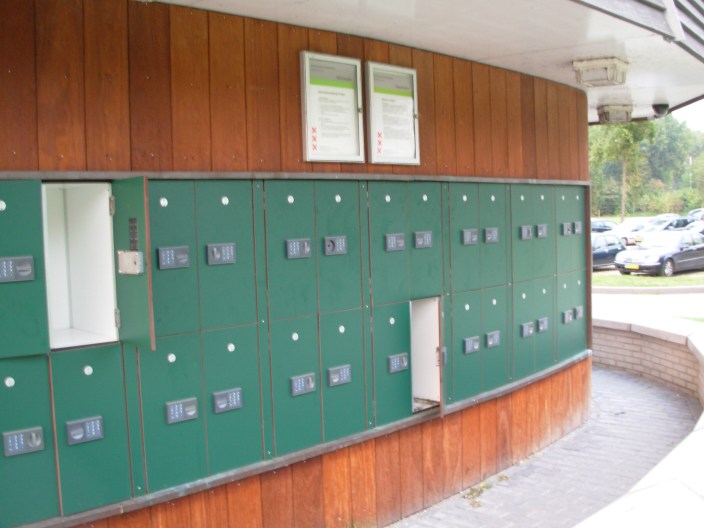
Lockers for runners, many do not work. Amsterdamse Bos near the restaurant.
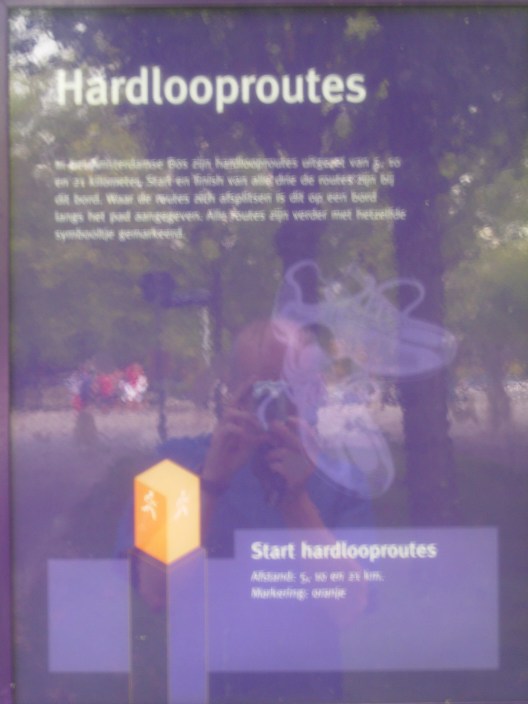
Sign with the start of the routes and the typical orange stone markers.
Low stone orange markers indicate the routes and these are present
at every turn-off. A route map is available from [1]
or
below.
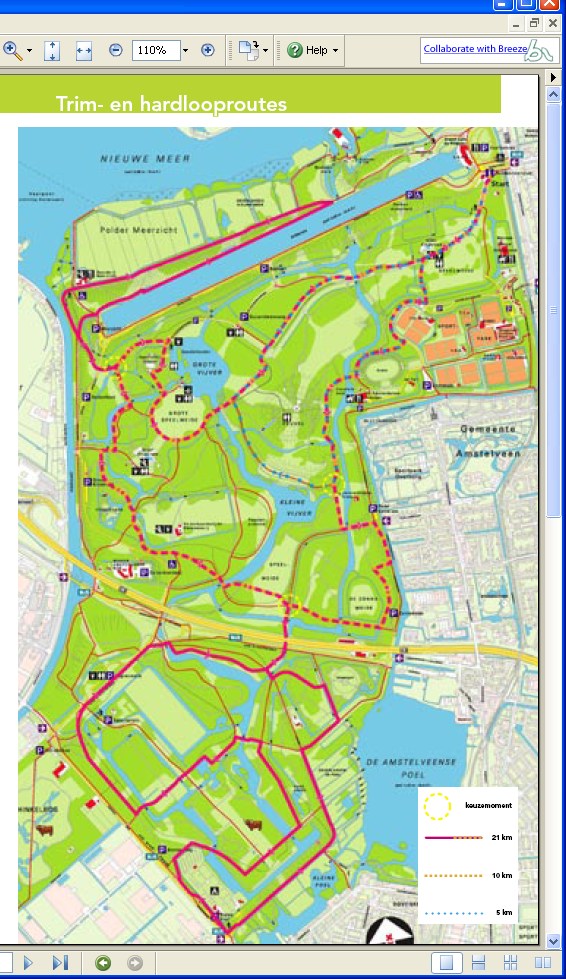 .
.
The 10 km is my favourite, mostly to test my physical shape once every one or two weeks. I use the 5 km for training runs or a power run (AFAP, As Fast As Possible) to build up stamina.
Other popular runs are the 5 and 10 km of the mid-summer night run that have more soft trails and a nasty hill at the last 2 km.
Map with the 10 km route and intermediate distances (approximate)
About 50% of the route consists of gravel trails and 50% of tarmac bicycle trails. If you do not like the hard bicycle tarmac trails you could generally move over to pedestrians gravel foot paths .
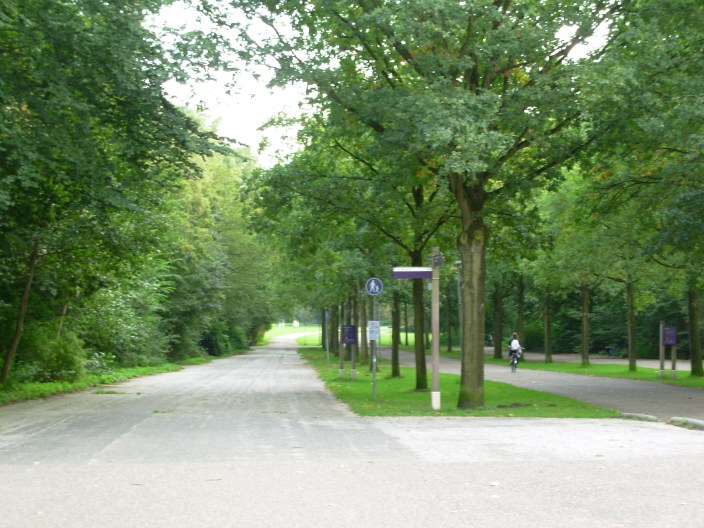
Start of run at two blueish/purple metal boards (near bicycle).
The start of the run is marked by blueish/purple metal boards South-East of the museum (and the Bosbaan). If you need a leak, as men frequently do, there are some nice dense bushes between the signs and the Bosbaan but it is more convenient (and cleaner) to go to the restaurant.
The route first goes down for 100 m and after about 600 m you are at the first turn-off to the left.

First turn-off left, after 600 m.
After a few hundred meter, you reach hockey fields. Turn right.
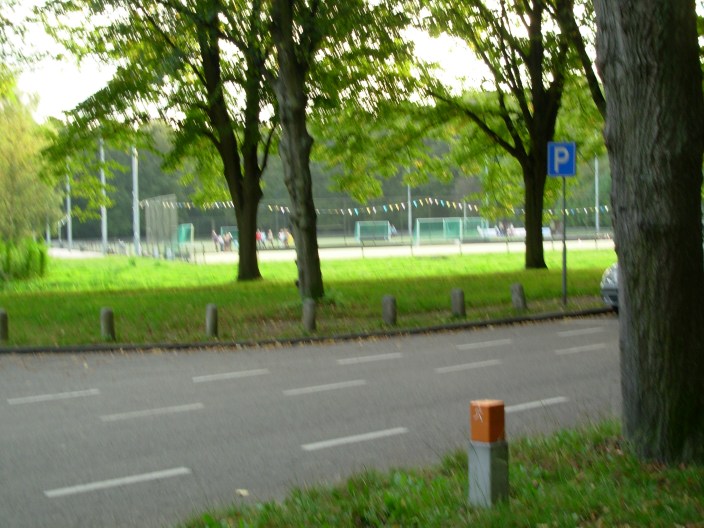
Hockey fields at the turn right.
The road make a long half circular turn and you have a choice to run on the gravel trail or the tarmac. The latter is shorter and faster.
After about 400 m there is a sharp turn to the right following a small tarmac road through a dark forest.

Sharp turn right at the hockey fields.
After again about 400 m you reach a bridge to your right. Cross the bridge.
You now follow a bicycle lane with a bit ups and downs and when lucky you could try to keep up with slow bicycles. From the bridge it is about 1 km to the split of the 5 and 10/21 km routes.
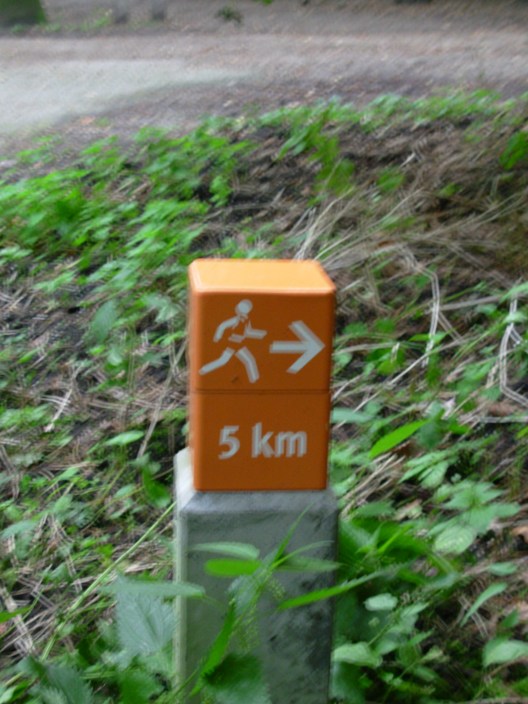
Sign for the 5 km route, after 2.5 km
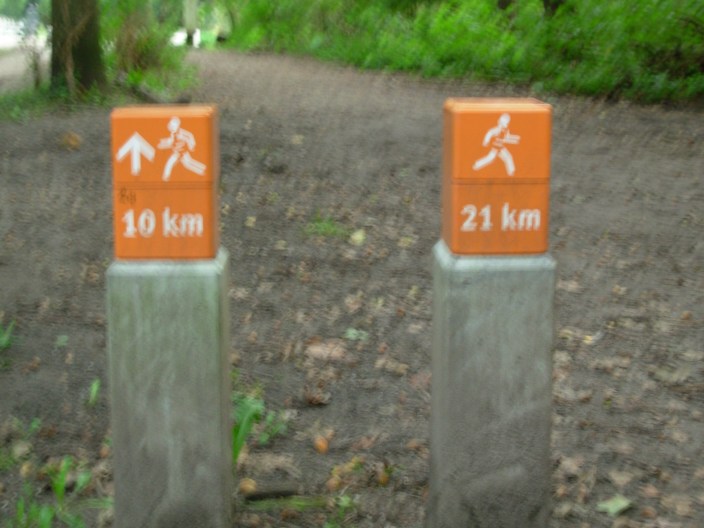
Signs for the 10/21 km, after 2.5 km
Turn right for the 5 km but go straight for the 10/21 km routes. After a hundred meters you pass a bridge and after another 300 meters there is a second bridge. Here you turn left.

Second bridge, after 3 km.
Follow the wide road that slowly goes up and after 200 m just before the exit of the park, take a 120 degrees sharp turn into the forest down a trail.
For the first time, the trail changes from the hard tarmac to gravel and now you should be thinking of a PR (personal record) as it is only another km to the decision point, the 4 km post, and your muscles should be warm now..

Split between the 10 and 21 km, after 4 km.
The 4 km post has a turn-off to10 or 21 km. Here you check you time. At 16 minutes and 20 seconds a few weeks ago I knew I would make it within the limit that separates runners from joggers, 40 minutes or an average of 15 km per hour for men.
This is around 45 minutes for ladies. They should be at just over 16 minutes after 4 km.
Looking back at the 4 km point, split of 10 and 21 km.
Go slightly right following a narrow trail across soccer fields [1] that can be very wet so I often take the nicer bicycle trail on the left side.
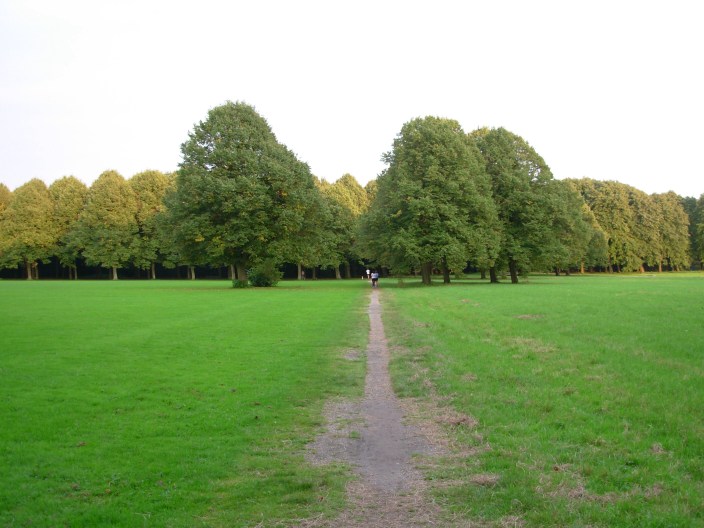
Narrow trail across the soccer fields, after 4.2 km.
You pass a bridge after 4.5 km.

Bridge, after 4.5 km.

Turn off past the bridge, after 4.6 km.
For the next 3 km the trail follows trails with various turns but they are all well marked. After about 7 km the post is 30 meters ahead on the far-left at about 20 m distance and this is not too well visible.
Past the open air theatre you finally hit hard ground again of a circular bicycle lane, another 2.6 km to go.

Circular bicycle lane with lady runner, first time, after 7.8 km.
At around 7 km, this may be the hardest part. Ignore the many pedestrians and cyclists.
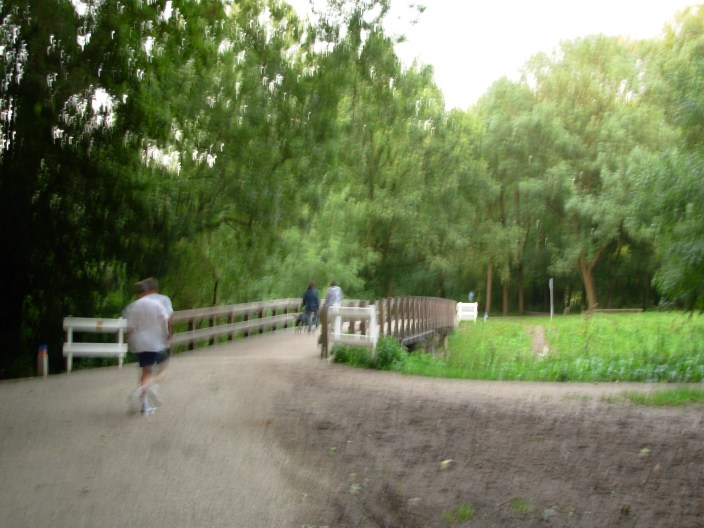
Bridge, after 7.9 or 8 km.
This bridge marks the 8 (or 7.9) km point, time to check your chronometer. I was at 31 minutes and few seconds a few weeks ago so I knew I would make it within 40 minutes.
The bridge, after 8 (or 7.9) km.
You pass a big stone block, a piece of art with many holes.
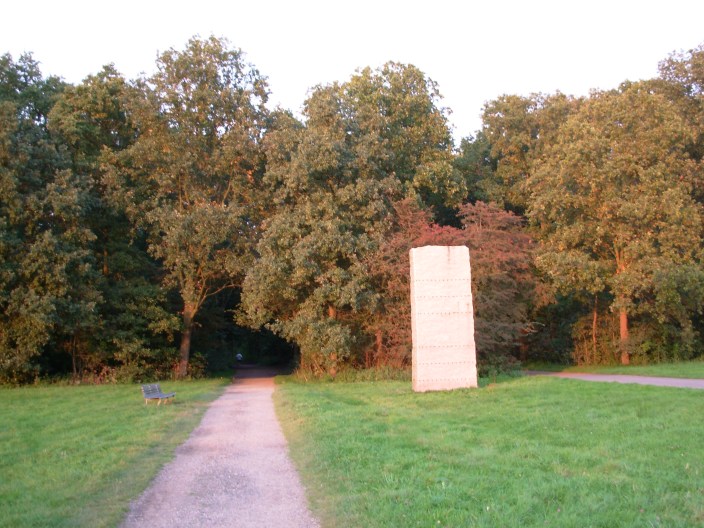
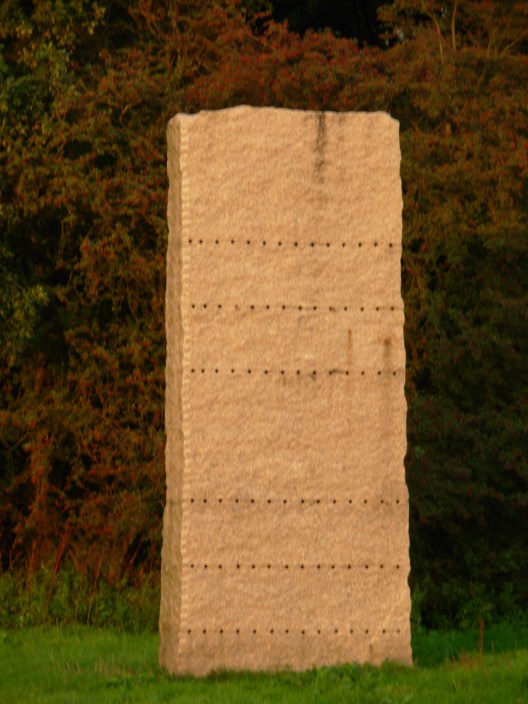
Big stone block.
After 400 meters you enter a very long lane lined with trees. On Wednesday night this may be a popular area for running, rowing and skating trainings.

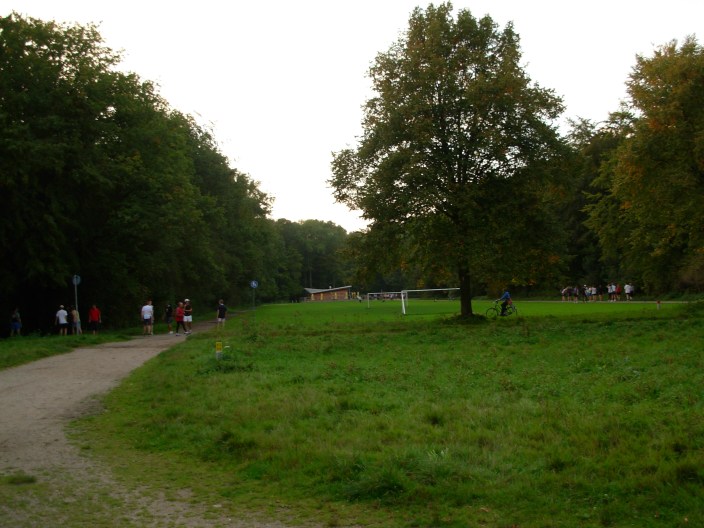
Lane with trees, after 8.4 km.
At the bridge it is still 1 km or perhaps even 1.1 km to go.

Past the bridge, after 9 km.
You reach the old turn-off point near the beginning, keep on going straight.

Earlier turn-off point, after 9.6 km.
Now you hit the hardest part, the last 500 m.
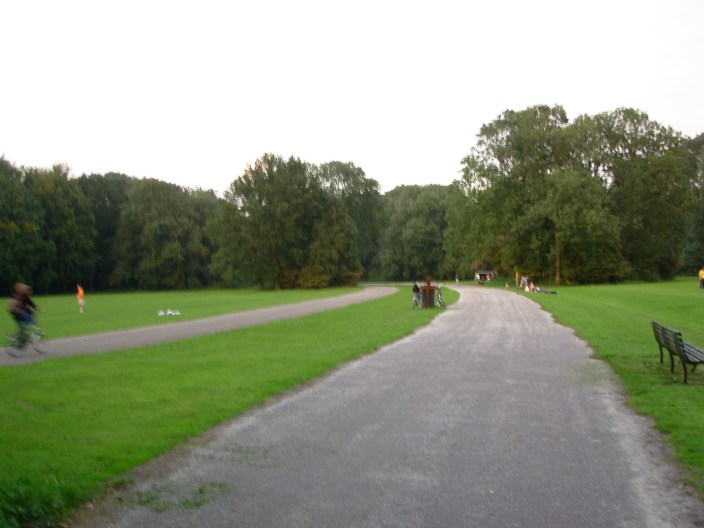
Last 500 m, after 9.5 km.
The last 100 m is up and can be very heavy for a doing a sprint. You should have started sprinted already after the 9.5 km point and only keep a steady pace the last 100 m.
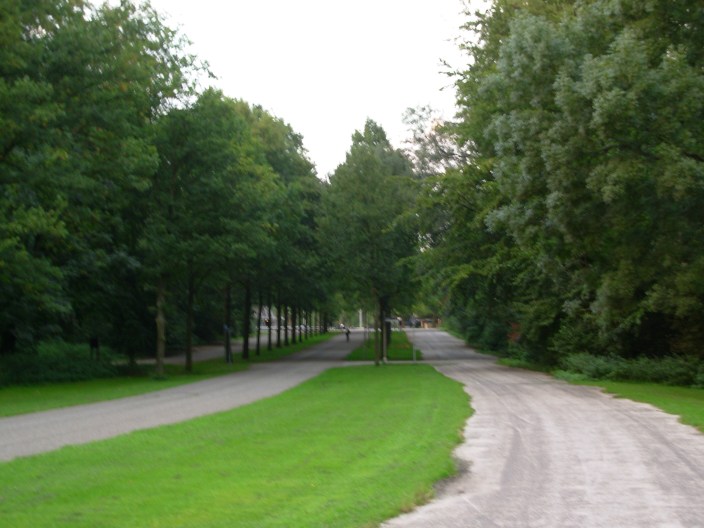
Last 100 m, going a bit up, after 9.9 km.
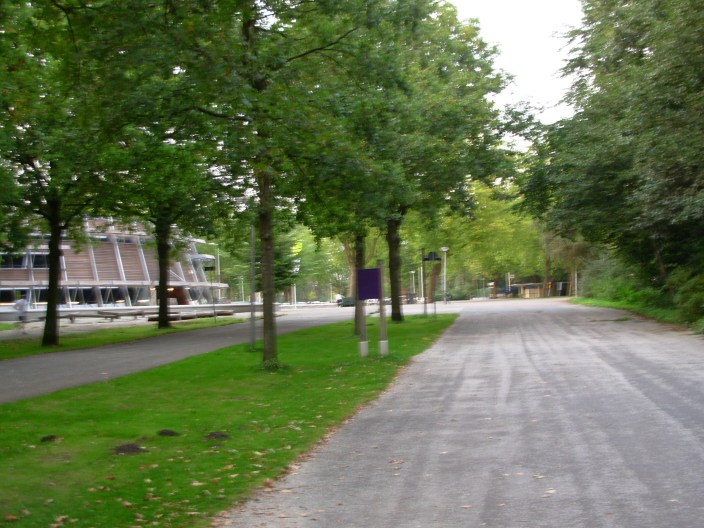
Purple sign with the finish, Bos museum on the left.
At the finish, you will meet will meet other runners doing some stretching and bending.
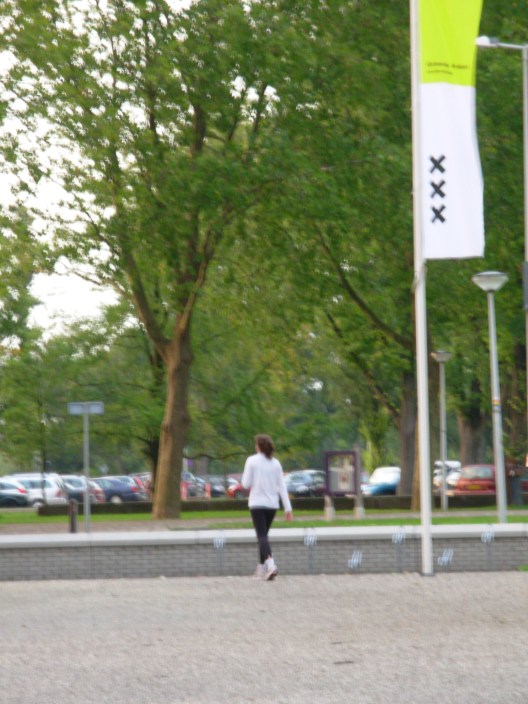
Lady runner (second time).
A few weeks ago I did this run below the magical limit of 40 minutes, in only 39 minutes and 44 seconds, best time ever.
I suspect the last 2 km from the bridge are a bit longer, by 100 m? At the bridge I was still at only 31 minutes and a bit, and I thought I would be close to 39 minutes..

PR on the 10 km: 39 minutes and 44 seconds.
Just made it within the magical limit! I am finally promoted from a jogger to a runner.
You are visitor # since September 2007.
![[1]](07bos4024fields4km.jpg)